Why does Gölgede Yaşam keep its pergola work in a single team?
The İzmir-based company keeps every stage in its own team, from measuring to installation. The choice gives customers one point of contact, and gives the company a fixed structure it has to carry.
WyvOne Editör ·
When you visit the site of a company that sells pergolas and glass systems, the first place you look is usually the product catalogue. The sentence that stands out at Gölgede Yaşam describes a way of working rather than a product: "No middlemen, no surprises." The İzmir company, founded in 2009, says it has completed more than 479 projects so far. What it leans on in the market is who does the work as much as the product itself.

What does the company sell?
The portfolio has six systems: automatic pergola awning, bioclimatic pergola, zip screen, glass roof, guillotine glass and sliding glass. Its customers fall into two groups. On one side are homeowners and villa projects, on the other businesses such as cafés, restaurants and hotels.

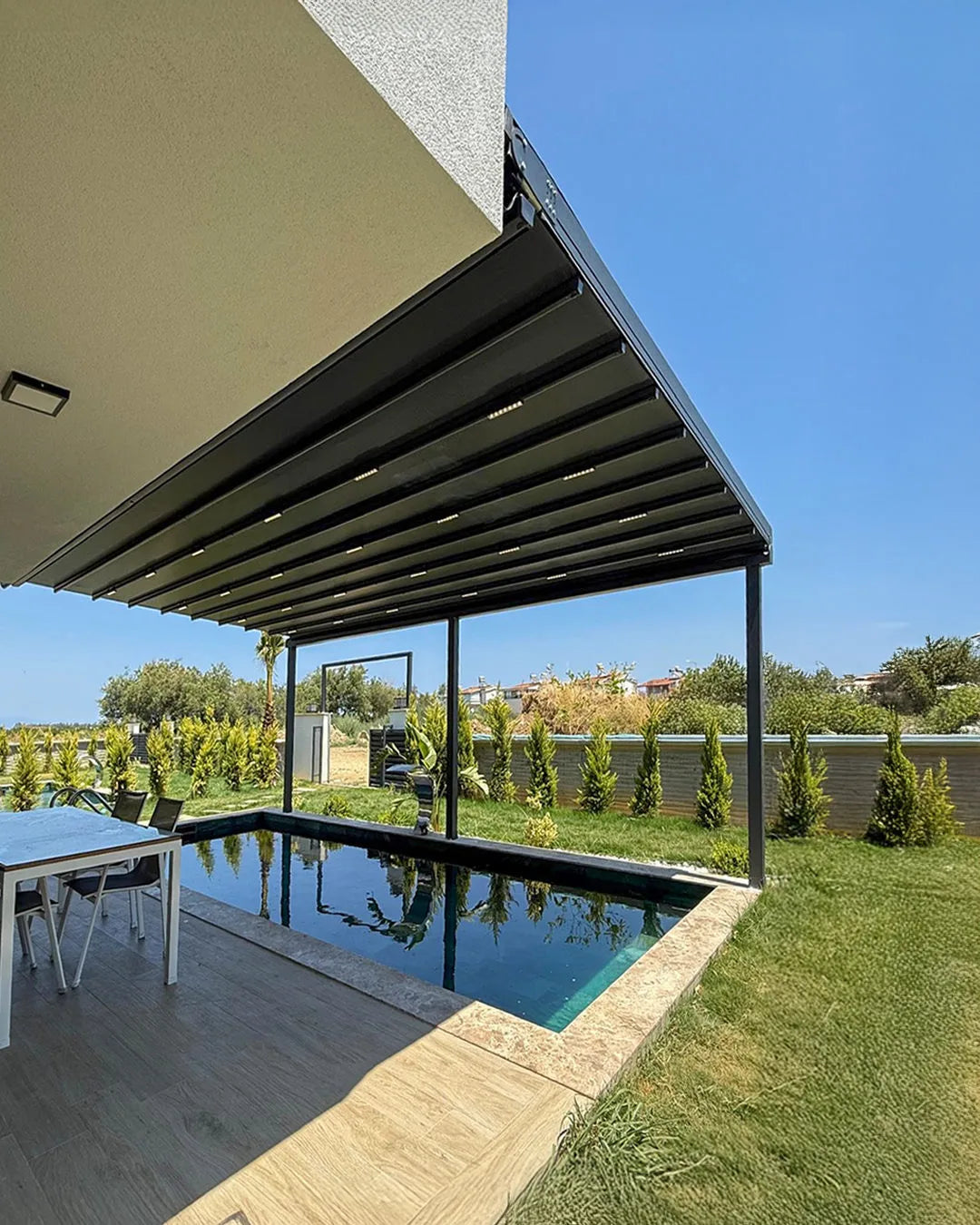
The products are sold on technical specifications. The bioclimatic pergola page says the aluminium blades rotate between 0 and 120 degrees, form a watertight roof when closed, and are rated for a snow load of 150 kg/m². RGB LED lighting and a remote control are also part of the package.

How does the single-team model work?
According to the company, the engineer who takes the measurements and the technician who completes the installation work in the same team. The aluminium profiles are cut and painted at the company's own facility in İzmir. The customer has one point of contact from the site survey to installation.
In management language this is called vertical integration: a company carrying out several stages of its value chain in-house instead of outsourcing them. In Gölgede Yaşam's case it is concentrated at the end of the chain closest to the customer: cutting, painting, measuring and installation.
What does this choice cost?
What the model offers the customer is clear responsibility. When a problem comes up, there is no need to go back and forth between the party that measured, the party that manufactured and the party that installed. Having the paint in the company's hands also gives flexibility on colour: the outer frame can be painted in any shade on the RAL chart.
The cost is a fixed expense. A company with its own facility and team has to carry that structure even when work slows down. Because outdoor work can be sensitive to the season, this is where the model is tested most. The company does not share turnover, profitability or capacity figures on its site, so the financial result of the model cannot be measured from the outside.

How is the sales process set up?
The company describes the process in four steps. In the survey, the space is measured on site. In the project stage, a structural calculation is made and the system is shown in a 3D image before it is built. Then the profiles are prepared at the company's facility, installation is completed in two days on average, and usage training is given.
The survey and price estimate being free means the company takes on the first cost of the sale. For a customer making an expensive and lasting purchase, the 3D image and the warranty are also tools that make the decision easier. The warranty is 5 years for pergola systems and 2 years for the other systems.
Where is the business case for commercial customers?
The commercial areas page targets cafés, restaurants and hotels. The argument here is capacity more than comfort: a business with a terrace does not have to carry its tables indoors when it rains. In other words, the investment is described through the promise of reducing the number of tables that cannot be used because of the weather. The company does not put a number on this; each business has to do the calculation with its own table and revenue data.

The company's references page lists names such as Starbucks, McDonald's, Folkart, Soyak MaviŞehir, Vogue Hotel Supreme and İzmir Doğal Yaşam Parkı (İzmir Natural Life Park). This list is the company's own statement; we did not separately verify the scope of the jobs.
Where is the limit to growth?
The primary service area is the Aegean: Bodrum, Çeşme, Alaçatı, Urla, Güzelbahçe, Fethiye, Göcek and Marmaris. The company also mentions projects in İstanbul, Ankara, Antalya, Sakarya and Bursa, and an export network that includes Germany, Saudi Arabia, Azerbaijan, Kazakhstan and Kyrgyzstan.

This is where the real test of the single-team model begins. Measuring and installing with the same team is easy around İzmir and harder in another country. The pages we read have no detail on how overseas jobs are carried out. How the "no middlemen" promise is kept as distance grows will be a deciding question for the company's growth plan.
The information in this article was taken from the company's website. Price and timing vary by project, so current information should be obtained from the company. Gölgede Yaşam is a WyvUP client; WyvUP worked on the company's website.
Sources
- Gölgede Yaşam: Ana sayfa
- Gölgede Yaşam: Bioklimatik Pergola
- Gölgede Yaşam: Ticari alanlar
- Gölgede Yaşam: Referanslar
- Gölgede Yaşam: Hizmet bölgeleri
Cover and in-article images: Gölgede Yaşam. Some of the images are the company's 3D work and may not show a completed project.


